AI SEO Company
in Bangalore
We Build Your Website and Your Google Business Profile as One System — So You Rank on Google Maps, Google Search, and AI Search
Designed to impress. Built to rank.
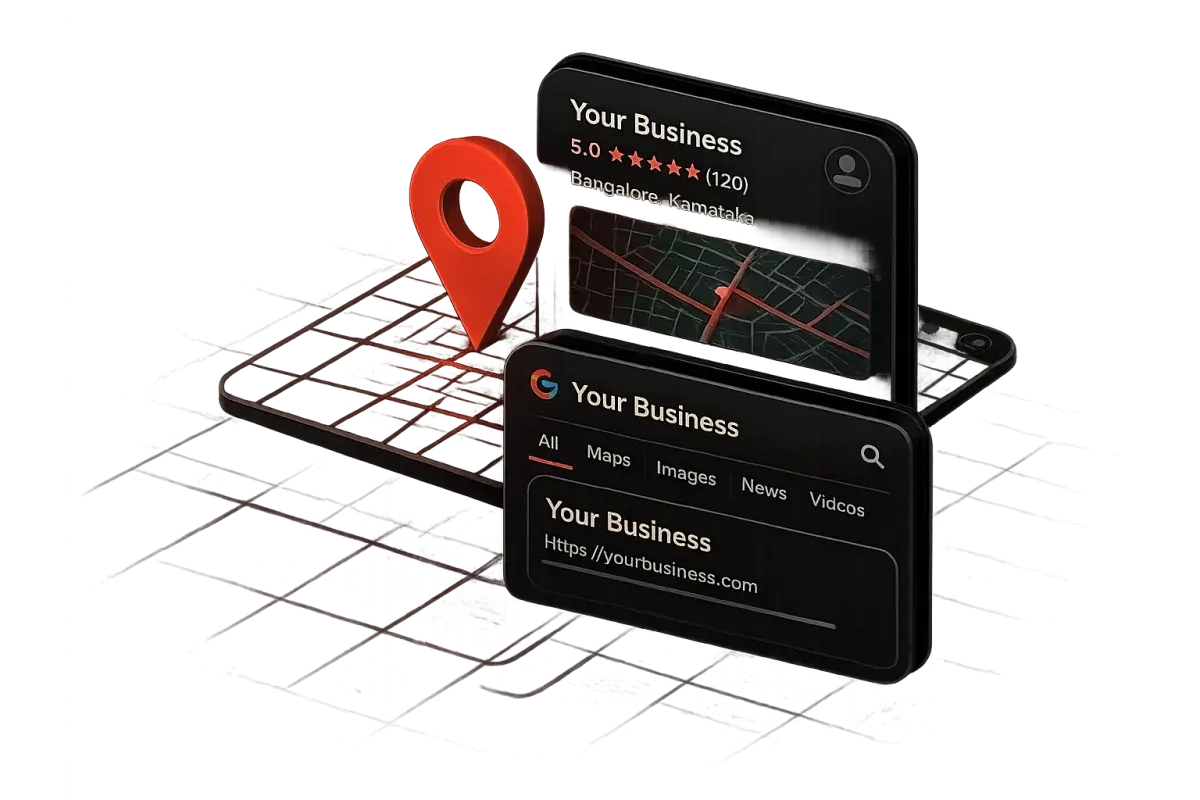
We Build Your Website and Your Google Business Profile as One System — So You Rank on Google Maps, Google Search, and AI Search
of people who search for something nearby visit a business within 24 hours
(Source: Google)more likely to attract location visits — businesses with a complete, well-aligned Google Business Profile
(Source: Google)countries now see Google AI Overviews — a third search channel most websites are not built for
(Source: Google, 2024)Most businesses in Bangalore that come to us have already spent money on a website. Many have also paid an SEO agency. Some have done both.
And yet their competitor — sometimes with a worse product, a smaller team, a less professional operation — ranks above them on Google Maps.
This is what is actually happening.
The web designer built the website. The SEO agency, if there was one, managed the GBP separately. Neither coordinated with the other. The website sends one set of signals to Google. The GBP sends a slightly different set. Created at different times, by different people, never built to work as one system.
Google sees two things that do not match. Google Maps ranks businesses it can verify by cross-referencing their website and their GBP profile. When the two contradict each other — even subtly — your ranking suffers. Your competitor with clearer, more consistent signals moves up. Not because their business is better. Because Google can read theirs more clearly.
Then there is the design problem layered on top of this.
Many businesses chose a website that looks polished — built to impress, not built to rank. Others chose an SEO-focused website that ranks slightly but reads like it was written for a crawl bot, not a human. When a customer lands on it, they leave.
"Beautiful but unfound. Or found but untrustworthy."
Both outcomes mean the website is not doing the job it was built to do.
And there is now a third channel where this gap is costing you: AI search.
When someone asks ChatGPT "best digital marketing agency in Bangalore" or searches Perplexity "which SEO company should I hire in Bangalore" — those results are pulled from websites with clear structure, consistent signals, and authoritative content. If your website is not built that way, you are invisible in that conversation.
Three channels. One website. One structural problem. One fix.
Most agencies ask you to pick a lane.
Rankings or design. Google Search or Google Maps. Organic SEO or AI search visibility.
We do not give you that choice.
An AI SEO company builds your online presence to rank across all three modern search channels — Google Maps, Google Search, and AI search — as one coordinated system, not three separate projects managed by three separate vendors.At Stunning SEO Websites, your website and your Google Business Profile are built as one unified system — architected from the start to rank on Google Maps, Google Search, and AI search, and to convert the visitors who arrive. Not separate projects. One build, one architecture — three channels and a stunning website that converts, all working together.
Before a single page is written, we align every signal the GBP sends to Google with the website — one consistent story, not two separate descriptions of the same business.
This is what Google Maps uses to verify and rank a business. When the two match exactly, Google trusts you and your ranking moves. When they diverge — which is what happens when a web designer and an SEO agency never speak to each other — a competitor with a worse business sits above you.
We close that gap by design, before the first page goes live.
Every page on the website has a specific job: target a keyword your customers are already searching. The homepage. The five category pages. Each individual service page. Each one is a precise, connected signal — built on the one above it, linked to the ones beside it.
No pages competing against each other for the same keyword. No thin content. A connected architecture that Google can read, map, and rank.
AI is not replacing SEO. It is creating a third search channel — one that rewards exactly what good SEO has always required: structured content, consistent signals, and clear authority over a specific topic in a specific location.
ChatGPT, Perplexity, Google AI Overviews — these tools do not search the web the way a person does. They read structured, authoritative content and surface the businesses that most clearly answer a query.
Getting found is the first job. Converting the visitor is the second.
A website that looks like a template converts like a template — even if it ranks. Every website we build is clean, professional, and built around the customer who lands on it. Not just around the search engine that sends them.
We build your website with the content format, schema markup, and entity signals these tools use when deciding who to recommend. If a buyer anywhere in the world searches for what you do in your city, we make sure your business is the answer they get.
You do not have to choose between being found and being trusted. We build for both.
Restaurants, clinics, retailers, coaches, consultants, service providers
You have a Google listing. You have a website. But when someone nearby searches for what you do, your competitor shows up — and you do not.
This is a signal problem — and it is what a local SEO company in Bangalore should fix first. We build your GBP and your website to tell Google the same story — so Google Maps knows exactly who you are, what you do, and where you are.
The result: you show up when someone nearby is ready to buy. Customers who searched for you. Not customers you had to chase.
Online stores selling across India and beyond
Every sale right now is costing you in ads. Organic traffic exists in your category — you are just not getting it.
We build e-commerce websites where every product page, every category page, and every piece of content is built to rank on Google Search and get cited in AI search results. The cost per sale drops over time. The organic traffic compounds. Less paid, more owned.
Brands with branches across cities, franchise networks, national chains
Some of your locations rank. Others are invisible in their own markets. The inconsistency is costing you customers in cities you have already invested in.
We apply the same unified system to every location — its own GBP profile, its own local SEO page, its own aligned signals. Every branch speaks the same language to Google. The inconsistency goes away. The performance becomes measurable across all locations.
Factories and exporters targeting buyers in Europe, the US, and beyond
International buyers no longer source at trade fairs first. They search on Google. They ask ChatGPT. They check Perplexity. A buyer looking for what you manufacture, in your city, from your country, is searching right now.
If your website is not built to rank for those searches, the buyer finds a competitor with the same product and a better-structured website. The inquiry goes to them.
We build manufacturer websites for this specifically — ranked on Google Search, visible in AI search, structured for the location-based searches international buyers use when sourcing from India. You do not need to travel to find the buyer. You need to be there when they search.
Another SEO agency. Another set of promises. Another round of monthly reports showing upward arrows while the business stays quiet.
We know that is what you are thinking. And we are not going to ask you to just trust us.
We are going to give you a way to check — right now, without knowing anything about SEO.
The way Google reads these two things — what your profile says about your business, what your website says about your business — do they tell the same story?
For most businesses in Bangalore, they do not. Close, but not quite. Built by different people, at different times, never built to work as one system. To Google, they look like two different businesses saying slightly different things about the same company.
That is the gap. That is why a competitor with a worse business ranks above you on Google Maps.
Google Maps ranks businesses it can verify. When your profile and your website send conflicting signals — even subtle ones — your ranking suffers. When they are built to say the same thing in the same way, Google trusts you more. The ranking moves.
At Stunning SEO Websites, both are built as one system — not two projects that happen to describe the same business.
What makes this structurally different:
One system — website and GBP built together from the start
Most agencies either build the website or manage the GBP. Rarely both. Almost never together. We build both from a single shared architecture — before anything goes live.
Design that earns the ranking — rankings that earn the design
A website that looks forgettable converts like one, even if it ranks. We build for both outcomes: the search engine that finds you and the customer who decides whether to trust you.
Built for the way search works today — not five years ago
Google Search. Google Maps. ChatGPT. Perplexity. Google AI Overviews. Five channels with different signals. One architecture that addresses all of them. Not added on as features. Built in from the first page. This is where search is going. The businesses building for all three channels now will have an advantage that compounds. The ones waiting are handing those searches to someone else.
One system that works at every scale
Single-location business in Bangalore. E-commerce brand growing organic revenue. Franchise managing twenty GBP profiles across cities. Manufacturer being discovered by buyers in seven countries. The system is the same. The application changes. The results compound.
Go back and compare your GBP against your website. If they are not telling Google the same story, you now know what has been holding your ranking back. And you know what we fix.
Get Your Free SEO Audit — Fix the Mismatch You Just FoundFive categories of services. One principle behind all of them: your website, your Google Business Profile, and your content are built to work together — not separately, not in sequence, not by three different vendors who never speak.
SEO, local SEO, Google Business Profile optimisation, content marketing, reputation management, and more
Search visibility that compounds over time. Local SEO for single-location businesses in Bangalore, e-commerce SEO for online stores, multi-location SEO for franchise networks — every service connected to the same unified architecture. Not standalone tactics.
Explore Internet Marketing Services →Google Ads, Meta advertising, PPC management, retargeting, lead generation
Paid campaigns built to work alongside your organic rankings, not replace them. Every campaign is built with the same understanding of your audience and search intent that drives the SEO strategy. Short-term visibility while the long-term system builds.
Explore Advertising Services →Content creation, blog writing, e-commerce marketing, marketing analytics
Content that ranks on Google and gets cited in AI search. Every piece answers a specific question your customers are already asking — structured so Google can rank it and AI tools can use it. Not content for its own sake.
Explore Marketing Services →SEO consulting, local marketing strategy, competitor analysis, growth consulting
Sometimes clarity comes before commitment. What is broken. What to fix first. What the architecture should look like for your specific business and customer type. A consulting engagement gives you that roadmap — without locking into a full build until the direction is clear.
Explore Consulting Services →SEO web design, business websites, landing pages, mobile design, small business websites
Website design and SEO in Bangalore — done as one project, not two separate briefs to two separate vendors. Every website we build is fast, clean, professional, and structured for Google Search, Google Maps, and AI search from the first page. Not a template. Not an SEO experiment. A website that looks like your business and works like a system.
Explore Website Design Services →You do not need to commit to anything yet.
The first step is simple: let us look at what you have — your website, your Google Business Profile, your current search visibility — and tell you what is missing and what to fix first.
No jargon. No report full of metrics that do not connect to revenue. A clear, honest picture of where you stand and what is costing you rankings right now.
What we look at in your free audit
Is your GBP sending Google the right signals? Is it consistent with what your website says? Is your profile complete enough for Google Maps to rank you?
Does your site send Google a clear signal about what you do and where? Are your pages working together as a system, or competing against each other for the same keywords?
Which keywords are you currently ranking for? Which ones should you be ranking for and are not? Where is the gap between what you offer and what Google shows?
Is your website structured so that ChatGPT, Perplexity, and Google AI Overviews can read it, understand it, and recommend you? Most websites in Bangalore are not.
The most common finding: a website and a GBP that were built separately and never aligned. We will show you exactly where yours diverge — and what it is costing you in rankings and visibility.
You will know what is broken, what to fix, and in what order. If you want us to build it, we will tell you how. If you want to fix it yourself, you will have everything you need.
No pressure. No obligation. No pitch dressed up as advice.
Just an honest look at what is there — and what should be.
Tell us about your business and we will get started.